Before we Start
- Link to the video
The content of the article is based on the video linked above. Mainly, we’re looking at Hormozi’s definition and components of “Mental Toughness”. Specifically, a model he devised to help us understand and improve it.
This article serves two purposes:
- A space for personal reflection.
- An additional visual guides and written interpretation.
What is Mental Toughness?
Onto the main topic, Hormozi defines mental toughness as:
The chance a bad thing changes how you act in a way that’s against your goals.
It took a few reads to understand his definition, but here is my take:
Mental toughness is our ability to act in line with our goals, even when bad thing happens.
So, in order to evaluate and improve our Mental Toughness, we rely on a model that Hormozi developed. It views Mental Toughness as a combination of components rather than one skill.
Here are the four components to Mental Toughness:
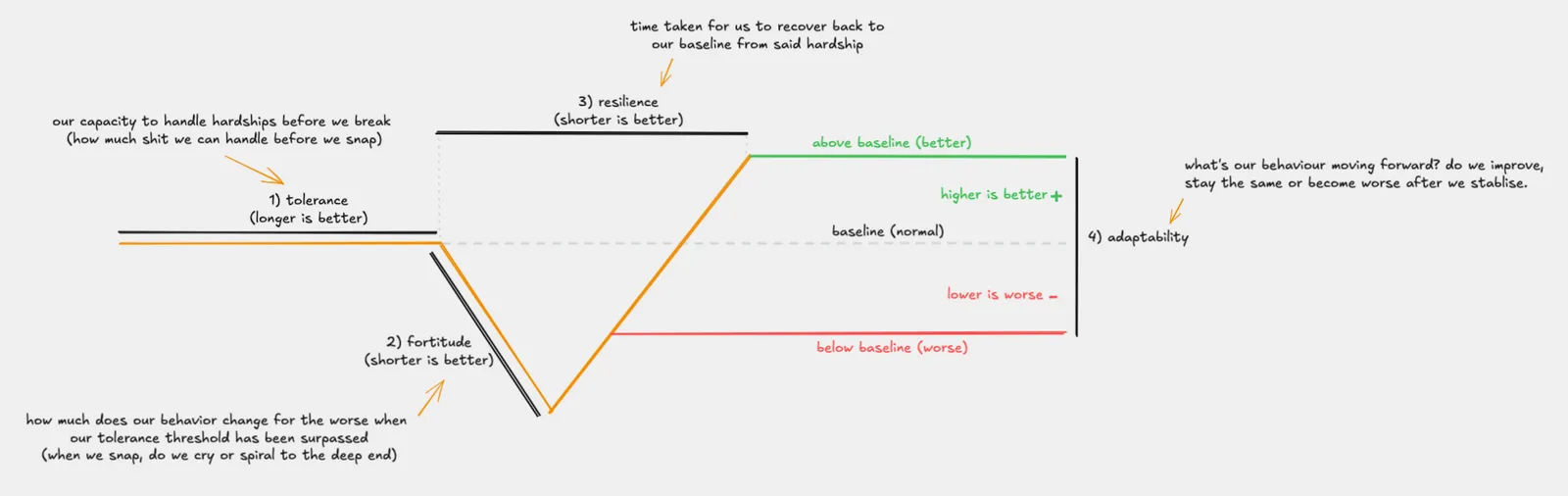
- Tolerance – Our capacity to handle hardships before we break. (How much shit can we handle before snapping.)
- Fortitude – How much does our behavior change for the worse when our tolerance threshold has been surpassed. (When we snap, do we cry or spiral to the deep end?)
- Resilience – The time taken to recover back to baseline from said hardship.
- Adaptability – What is our behavior moving forward? Do we improve, stay the same, or become worse after we stabilize?
- Become better – life beat strength into us (we became stronger after the hardship)
- Stay the same
- Become worse – life beat the strength out of us (we became weaker after the hardship)
Visualising the model
The following diagrams show us how each component plays out when we are faced with a hardship.
Step-by-step breakdown
This is a step by step breakdown on how each component: 1) tolerance, 2) fortitude, 3) resilience, and 4) adaptability function when we face a challenging hardship.
What actually happens?
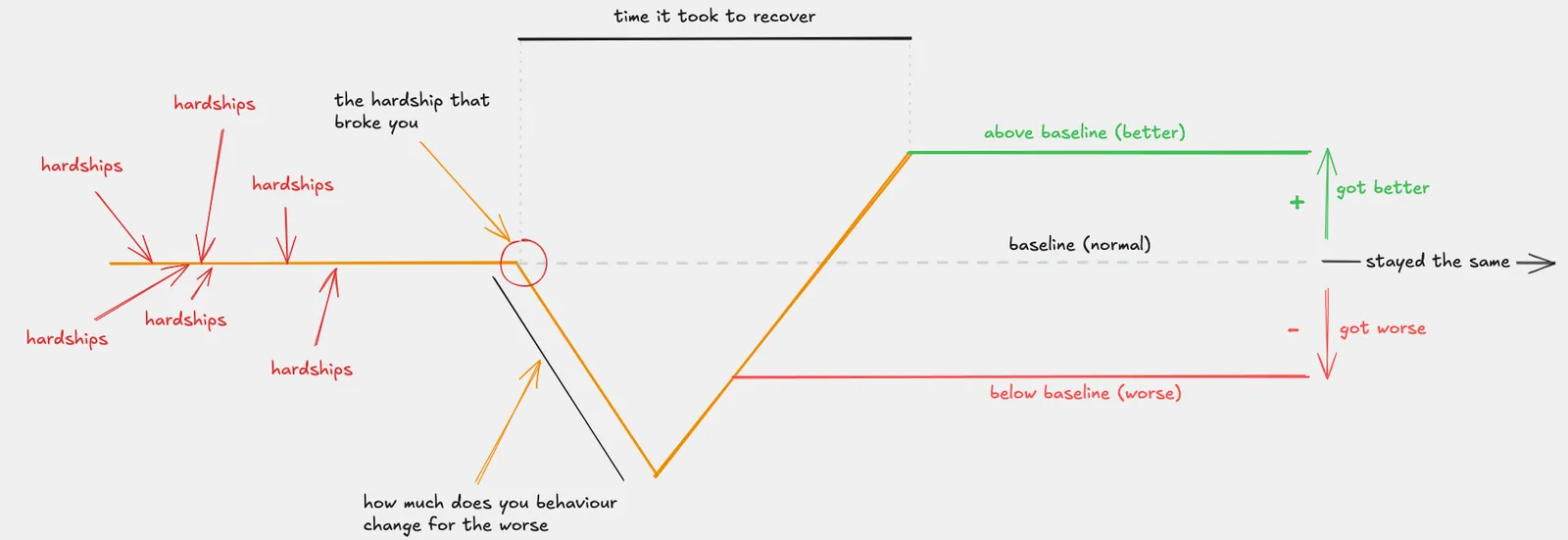
This is an example of how a setback might play out in practice – the moment you hit your tolerance threshold, how much does your behavior change, how long it takes to recover, and whether you emerge strong or weaker.
Examples
Here are some examples of how each component, at different scales, contributes to our mental toughness.
Extreme Ends
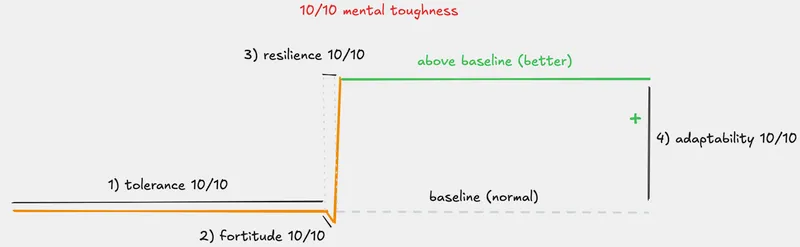
10/10 Mental Toughness (Ideal)
- 10/10 tolerance – Not much bothers them.
- 10/10 fortitude – Even when it does, their change in behavior is so small or subtle as it does not affect them.
- 10/10 resilience – They recover or bounce back almost immediately.
- 10/10 adaptability – They use the experience to get better.
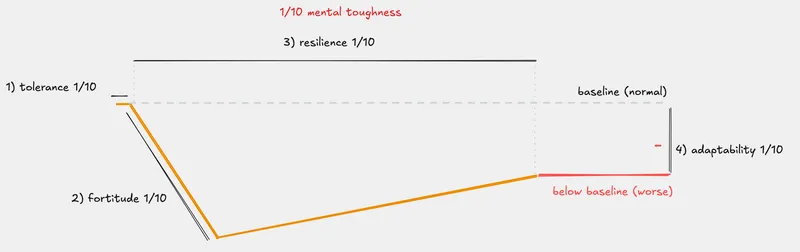
1/10 Mental Toughness (Fragile)
- 1/10 tolerance – It bothers them almost immediately.
- 1/10 fortitude – When it bothers them, they’ll start making more bad decisions and their behavior changes for the worse.
- 1/10 resilience – They take forever to recover from it or stay down for a long time.
- 1/10 adaptability – Despite recovery, they appear to have lost their mojo or drive as the experience made them worse off.
Mixed Profiles (Real Life)
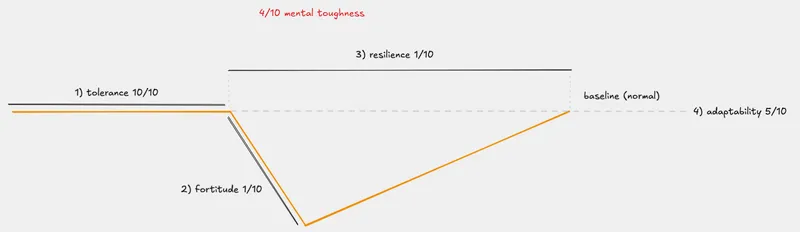
4/10 Mental Toughness (Slow Burn, Big Snap)
- 10/10 tolerance – They take a really long time before they snap.
- 1/10 fortitude – When they snap, it’s a huge one (behavior change for the worse, start acting out or even spiralling).
- 1/10 resilience – They stay upset for weeks.
- 5/10 adaptability – Weeks passes, and they come back to baseline without changing their behavior.
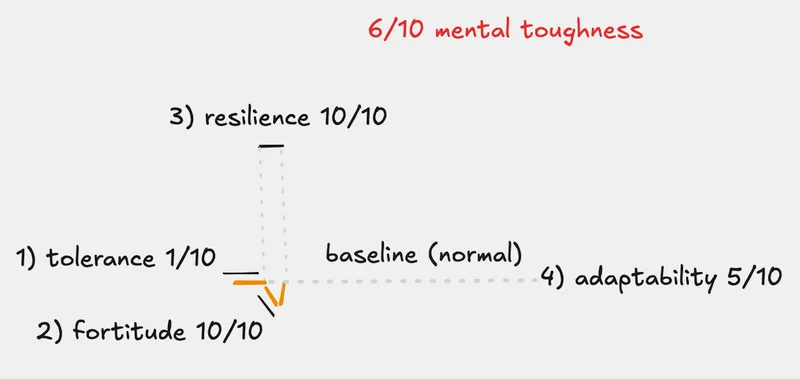
6/10 Mental Toughness (Short Fuse, Quick Recovery)
- 1/10 tolerance – A lot of things bother them.
- 10/10 fortitude – But their behavior rarely changes for the worse, at most they just get in a bad mood or cry.
- 10/10 resilience – They recover quickly.
- 5/10 adaptability – They come back to baseline without changing their behavior.
4/10 mental toughness (Easily Bothered, Slow Recovery)
- 1/10 tolerance – A lot of things bother them.
- 10/10 fortitude – But their behavior rarely changes for the worse, at most they just get in a bad mood or cry.
- 1/10 resilience – But they stay upset for weeks.
- 5/10 adaptability – Weeks passes, and they come back to baseline without changing their behavior.

Close the Gaps
With the examples covered, we can shift our focus to improving any components that we are lacking. The following shows us what to do when we have:
Low tolerance
- What it looks like – You’re easily annoyed, upset, bothered or frustrated at someone or something. They may have name called you, insulted you, or you were put in a situation against your preference.
- How it sabotages you – You’re giving others control over your behavior. If they can upset you, they control you.
- What to do instead
- Remember what you can and can’t control. When you’re upset, it puts you in a highly emotional state, giving in is not the appropriate response. Instead, realize that you cannot control the situation or behavior of others, however, you can control your response to it. So practice not giving power to someone or something to ruin your day.
- One-line mantra – “Be bigger than the pain”
Low fortitude
- What it looks like – You’ve snapped. You’re lashing or acting out in a situation. Can be doing the same thing as what someone did to you or worse getting physical about it. Your behavior changed for the worse.
- How it sabotages you – Make more mess for yourself to clean up afterward, and you’re prone to making more bad decisions to compensate for the one you just did.
- What to do instead
- Before you take another step or do something about it, take a deep breath. Start weighing the pros and cons of what you’re about to do, if it’s filled with pros go ahead and do it. However, if it’s filled with cons, don’t do it as it sounds like another bad decision to be made. You want to catch yourself before you make another bad decision, this way you can break the momentum of making even more bad decisions.
- One-line mantra – “Slipping once is enough”
Low resilience
- What it looks like – Feeling sad or disappointed at yourself for lashing out.
- How it sabotages you – Stuck in a state of limbo, making it difficult to realize that you need to take actions to better the situation.
- What to do instead
- Remember that beating yourself up in the situation, does not make the situation better. Feeling bad does not serve you, all it does is make you procrastinate against the need of taking action. You need to break the direct link between how you feel and how you act, only then you’re on your way to taking action.
- One-line mantra – “Act independently of how you feel”
Low adaptability
- What it looks like – Decides not to do anything about it, you’re willing to stay stuck in the situation and never learning from it.
- How it sabotages you – For every similar hardship in the future, you don’t learn, and you get worse off. Because you did not learn from it, you’re going to suffer through it all over again.
- What to do instead
- Take a piece of paper and pen and ask yourself, how can I let this bad thing serve me? Do I want this hardship to hold me back from what I can achieve in the future? If not, what can I learn from it to do differently?
- One-line mantra – “Don’t be sorry, be better”
Conclusion
It’s not life-changing advice, insights does not lead to action. Efforts need to be made for us to improve areas that are lacking.
However, I hope that this write-up creates awareness in us when we respond to hardship. Asking ourselves: which of the four components do we lack? Once it has been figured out, we can start working and improving on them. Thus, when a similar situation occurs in the future, we can hopefully handle it better based on what we’ve learned.
One more phrase from Hormozi:
Just because you feel like shit, doesn’t mean you need to act like shit, treat other people like shit or treat yourself like shit. Separating our feelings from how we behave is a sign of maturity, which has nothing to do with how old you are, only how skilled you are. And that means you can work on it, and if that is not a hopeful message, I don’t know what is.
Lastly, rate yourself on a scale of 1 to 10 on each component, see which one is lacking, and improve on it. This way, we know exactly what needs improve and can focus on efforts there.