table of contents
Open table of contents
overview
other than knowing how to calculate and estimate the electrical cost of our hardware, we need to be aware of the electrical components that powers our home lab to make safer purchases and avoid damaging our devices.
wall outlet
there are quite a few wall outlets across different rooms in our homes. we use it to power our home lab by plugging our device into it.
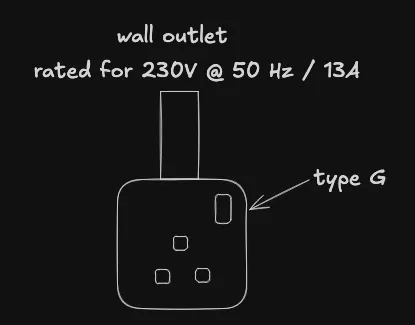 in Singapore, most households has a type G wall outlet rated at 13A / 230V @ 50hz.
each wall outlet, has a one or two socket, meaning only one or two devices can be powered at a time. installing more wall outlets throughout isn’t practical, so we reach for a power strip to extend the wall outlet.
power strips
power strips allow for more devices to share a wall outlet electricity. it provides at least two or more electrical sockets, enabling multiple devices to be plugged in such as monitor, laptops, desktop, phone charger and so.
these devices are powered with one wall outlet, with a power strip having multiple electrical socket.
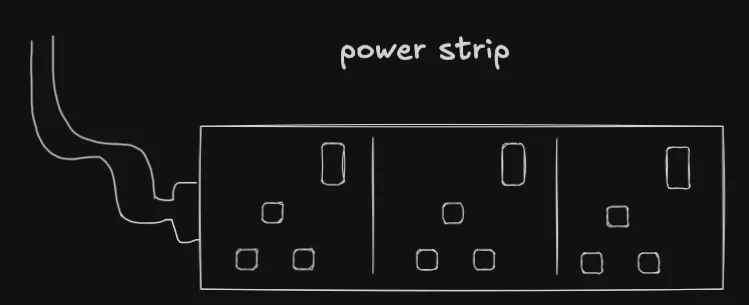
a few things to note about a power strip:
- each power strip has its own rating. it can be rated at, higher or lower than the wall outlet.
- the power strip distributes the wall outlet power across all the sockets. e.g. if a power strip is rated at 10A, and it has 4 electrical socket. this is shared across all socket, and it doesn’t mean that each socket is 10A.
- an electrical cord length affects the resistance of a power strip. the longer the cord, the more resistance the power strip can face. affecting the total power delivered to the power strip
- most power strip sellers do not specify the thickness of the cables within its electrical cord. in Singapore, we can assume its around 1.2 ~ 1.5mm^2
power strip rating
a power strip rating tells us how much power it can SAFELY draw from the wall outlet before overheating.
if the strip rating is lower than what the connected devices demand. i.e. wall outlet 13A; power strip 10A; devices collectively draw 11A, the strip will overheat, melt and potentially cause a fire as the circuit breaker won’t trip until 13A is exceeded.
so ideally, a power strip should be rated at or above the wall outlet. i.e. wall outlet 13A; power strip 13A; devices collectively draw 14A. instead of the strip overheating, the circuit breaker managing the wall outlet will trip first and cut power safely.
electrical cord
the length of a power strip electrical cord affects the resistance. the longer the cord, the more resistance, and the more power is lost as heat before reaching the connected devices.
anatomy
here’s how an electrical cord looks like on the inside
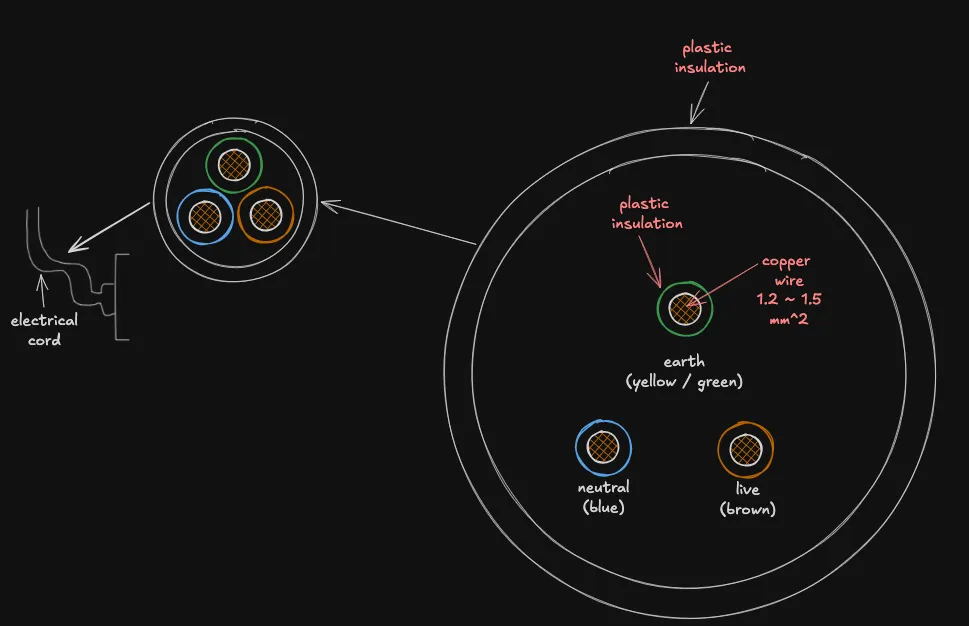 it consists of three cables: earth, neutral and live. each copper wire being roughly 1.2 ~ 1.5mm^2 thick.
with the anatomy in mind, we can proceed to look at the formulas to calculate resistance and power loss.
resistance of a single cable
Where:
- = resistance (ohms)
- = cable length (metres)
- = wire thickness (mm²), typically 1.2 – 1.5 mm²
- = copper wire resistance
total resistance of two cables (live + neutral)
out of the three cables, only the live and neutral wire will carry power. so we need to factor in the resistance of two cables based on its length.
power loss as heat
Where:
- = power lost as heat (watts)
- = current draw (amperes)
examples
with the formulas above, lets go through a few example on how the different lengths of electrical cord affect our total power draw
we’ll assume the wall outlet is rated at 13A/230V, allowing devices to draw up to 2,990W
power strip rated UNDER wall outlet
https://shopee.sg/VANENIK-Power-Socket-Extension-Cord-With-GaN-30W-USB-UK-Plug-Singapore-with-Overload-Surge-Protector-Power-Strip-3-Meter-i.425012199.18052721760
 This VANENIK strip is rated at 10A/220V = 2,200W with a 3 metre cord, which is below the wall outlet’s 2,990W
The strip becomes the limiting factor. If the connected devices draw more than 2,200W, the strip overheats and potentially catches fire.
The electrical cord length further reduces the power delivery:
- resistance of a single cable
- 0.0175 × (3 / 1.2) = 0.04375 ohm
- total resistance (live + neutral)
- 0.04375 × 2 = 0.0875 ohm
- power loss
- 0.0875 × 10² = 8.75W
- actual power delivered
- 2,200W − 8.75W = 2,191.25W
the usable limit becomes 2,191.25W, not the rated 2,200W.
power strip AT or ABOVE wall outlet
https://shopee.sg/2-3-4-5-6-Gang-Extension-Socket-with-Singapore-Safety-Mark-(2-3-6-Meters)-i.18174855.3657849177?extraParams={%22display_model_id%22%3A22278975614%2C%22model_selection_logic%22%3A3}
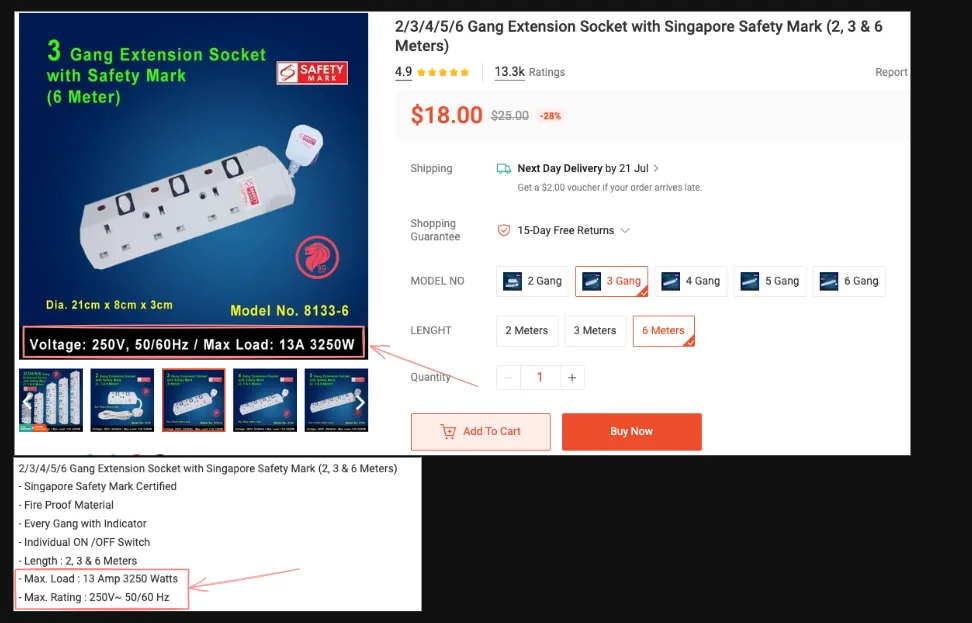 This power strip is rated at 13A/250V = 3,250W with a 6 metre cord, which is above the wall outlet’s 2,990W
compared to the previous example, the strip is not the limiting factor! if connected devices exceed 2,990W, the circuit breaker managing the wall outlet will trip first before the strip overheats.
let’s see how an increased cord length affect the power delivery:
- resistance of a single cable
- 0.0175 × (6 / 1.2) = 0.0875 ohm
- total resistance (live + neutral)
- 0.0875 × 2 = 0.175 ohm
- power loss
- 0.175 × 13² = 29.575W
- actual power delivered
- 3,250W − 29.575W = 3,220.425W
the usable limit becomes 3,220.425W, not the rated 3,250W.
conclusion
hopefully this gives a better understanding of how wall outlets and power strips work together to power our home lab.
ideally, try to choose a power strip that is rated at or above the wall outlet. this way the circuit breaker can trip if the connected devices over draws.
also, while the electrical cord resistance is usually negligible in practice, it’s worth keeping in mind when choosing a rather long cord like > 10m.